


Trump’s *God Bless the USA* Bible is a King James Version. $59.99. Printed in China. Packaged with the Constitution, the Bill of Rights, the Declaration of Independence, and the handwritten lyrics to Lee Greenwood’s anthem. Trump earned $1.3 million licensing his name to it in 2025 alone. Amendments 11 through 27 of the Constitution — the ones abolishing slavery, establishing equal protection, guaranteeing due process are missing.
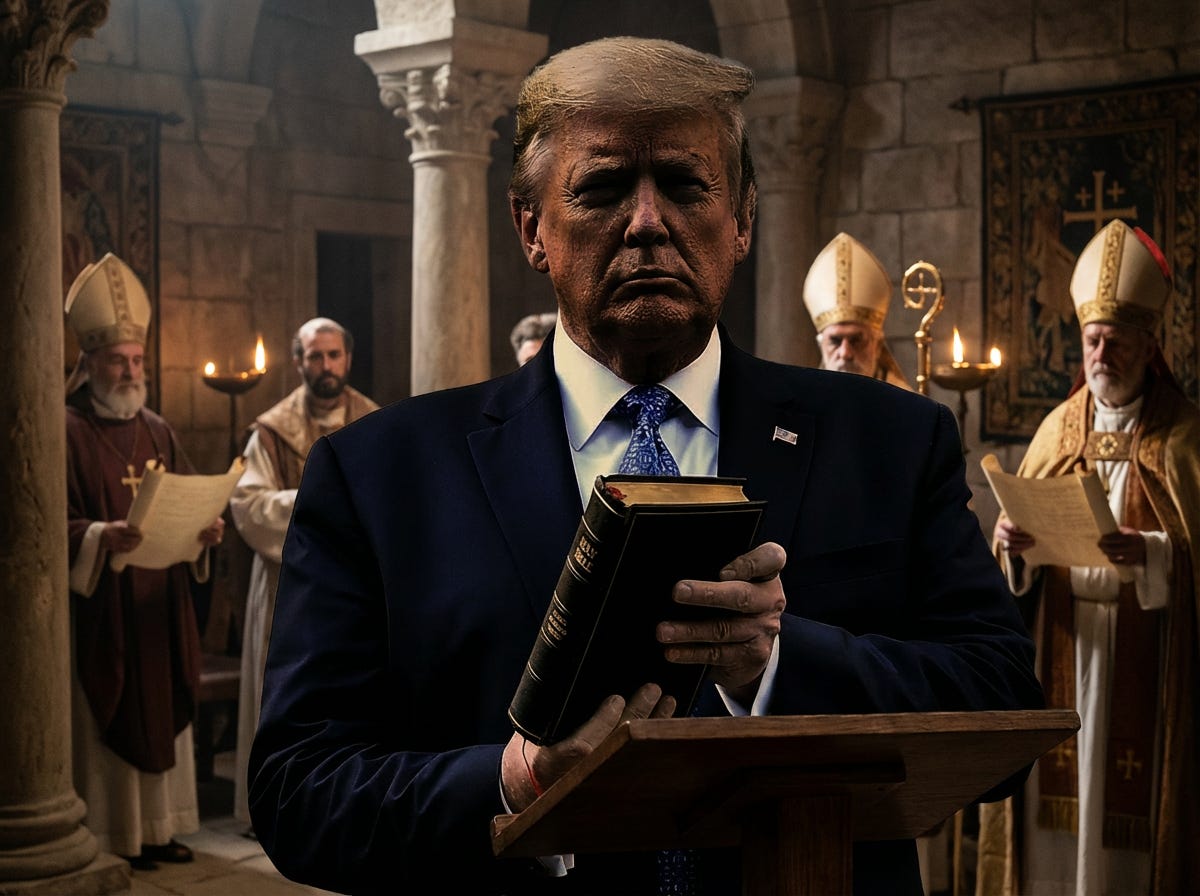
The missing story
In the first book of Esdras there is a story called the Contest of the Three Guardsmen. It has spent sixteen hundred years in and out of the Bible depending on who was in charge.
While King Darius sleeps, three of his bodyguards devise a contest. Each writes his answer to the question: what is the strongest thing in the world? They place their answers under the king’s pillow.
When he wakes, he reads them and convenes the assembly. Power subject to judgment before it knows it’s being judged.
Wine, says the first, makes every man equal —king and slave alike forget themselves, forget their debts, forget their grief.
The king, says the second guard, commands all things and everyone obeys him.
The third guard, later identified as Zerubbabel, wrote: *women gave us life, but above all things, Truth is victor*.
When Zerubbabel argues his case he acknowledges that wine is powerful and that kings rule. But Truth, he says, outlasts them all. Bold words spoken to a king. Literally speaking truth to power.
He goes on:
“With her there is no accepting of persons or rewards; she does what is righteous rather than what is unjust or evil.”
The assembly declares Truth the winner. King Darius accepts the verdict. He tells Zerubbabel to name his reward. Zerubbabel does not ask for money or power. He asks for permission to rebuild Jerusalem and the Temple.
This concept of truth having no partiality runs through Torah and Talmud as a cornerstone of justice. Leviticus. Deuteronomy. Justice is not the king’s to control, it’s above him. (Leviticus 19:15, Deuteronomy 16:19, Mishnah Avot 1:18)
*Magna est veritas et praevalet.* Great is Truth, and it prevails.
The Augustinian Trap
1 Esdras was in the Bible Christians actually used for the first four centuries.
In 397 CE the Council of Carthage, attended by Augustine of Hippo, ratified a canon listing “two books of Esdras.” The story of Zerubbabel and the king was scripture.
Augustine re-frames the story to fit his own purpose. He says Zerubbabel is either talking about Christ or he’s wrong.
He argues: “unless, perhaps, Esdras is to be understood as prophesying of Christ in that passage where, on a question having arisen among certain young men as to what is the strongest thing... that same third youth demonstrated that the truth is victorious over all. For by consulting the Gospel we learn that Christ is the Truth.”
Zerubbabel said Truth needs no mediator and can defeat kings, a direct threat to Augustine's premise in the City of God that the Church is Truth's mediator. This is the Augustinian Trap — the logical fallacy explored in my last piece.
The story wouldn’t last for long. Eight years after the Council of Carthage, Jerome finished his Latin translation of the Bible. Jerome and Augustine were collaborators — exchanging letters, sharing enemies, building the same church.
Jerome put 1 Esdras in an appendix. He marked it “apocryphal” from the Greek Apokryptein — to hide away, to conceal. No council authorized this. He unilaterally made the call, and the story of Truth defeating kings disappeared from the Bible of the Western church.
The Council of Trent convened to answer the Protestant Reformation and upheld Jerome’s arrangement in 1545-1563.
In 1534 Martin Luther demoted the Apocrypha to a separate section of his German Bible. Present but not equal to scripture. *(Luther Bible, 1534, Apocrypha preface)
The British and Foreign Bible Society, the largest distributor in the world, whose editions reached every corner of the world, stopped including the Apocrypha in 1826. The most read Bible in the world no longer contained the Contest of the Three Guardsmen. *(Canton, A History of the British and Foreign Bible Society, 1904)*
Scholars have solid reasons for its exclusion like unreliable sourcing, repetition of material found elsewhere. But the Book of Judith is acknowledged as historical fiction by Catholic scholars themselves: wrong geography, impossible chronology, a city that never existed. It stayed. The story where Truth defeats the king did not.
The story where Truth defeats the king did not.
Augustine’s arguments originated at a moment of crisis, when he decided to attack reason to save the Church. It’s worth noting that the theologians ancient and contemporary who follow him agreed
The Three Guardsmen story remains fully canonical scripture in Eastern Orthodox and Ethiopian Orthodox churches. It has never been removed from their Bibles.
So, for sixty bucks, Trump could at least include this story and the rest of the constitutional amendments buried in an appendix. Well, now for free you can sign up for his Truth Social and get the real facts. Augustine 101.
---
Sources:
1 Edras https://bible.oremus.org/?ql=642568301
Augustine, City of God, Book XVIII, chapter 36. Lawrence M. Wills, Introduction to the Apocrypha, Yale University Press, 2021. Council of Carthage (397 CE), Codex Canonum Ecclesiae Africanae. Leviticus 19:15. Deuteronomy 16:19. Mishnah Avot 1:18. Denzinger, Enchiridion Symbolorum, 1501-1508. Canton, A History of the British and Foreign Bible Society, 1904.*
Book of Judith: Michael D. Coogan, ed. (2010). The New Oxford Annotated Apocrypha: New Revised Standard Version (4th ed.). Oxford Univ. Press. pp. 31–36