


Every conversation about what’s wrong with America eventually hits the same wall. Someone brings up immigration, taxes, healthcare, war and before long you’re not talking about policy anymore. You’re asking why people believe things that are demonstrably false.
Why does your neighbor think immigrants are why he can’t afford rent, when wages have been suppressed by corporate policy for forty years and housing consolidated by private equity? Why does your uncle believe cutting taxes on billionaires will make him richer, when it’s been tried repeatedly and consistently hasn’t worked? Why do millions believe Donald Trump is going to lower the deficit when his actions show otherwise? Why do people see mass voter fraud as the threat to democracy and not voter suppression? Why does anyone still think dismantling the ACA would make healthcare better, when virtually every country with universal coverage spends less and lives longer?
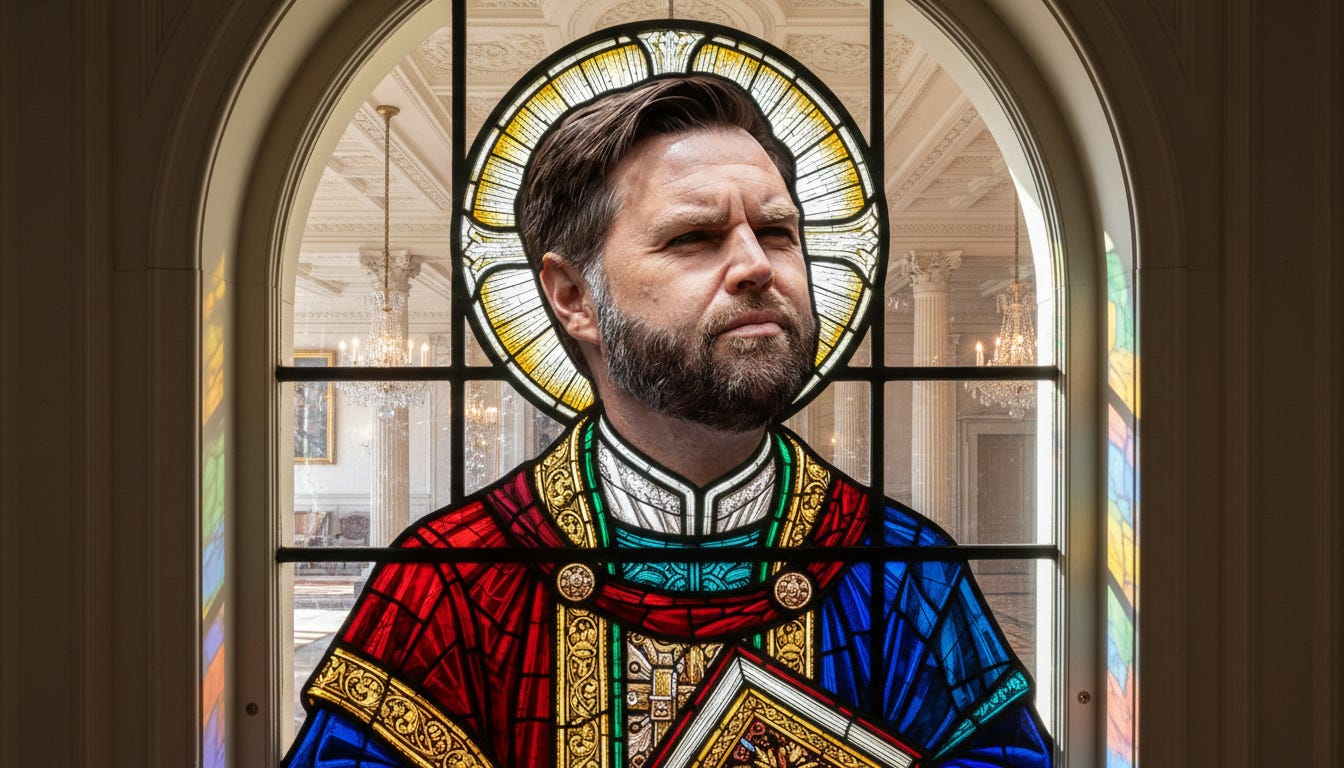
Half the country isn’t stupid. These are people who navigate complex lives, raise children, hold jobs, and sometimes accomplish brilliant things. Ben Carson performed brain surgery on children. Elon Musk lands rockets on drone ships in the ocean. Amy Coney Barrett is a constitutional law professor and Supreme Court Justice. These are not people incapable of reason.
So what is happening?
To answer that you have to go back. Way back. To a specific moment in our timeline — an epistemological earthquake that shifted Western civilization from using reason as the gold standard for knowledge to questioning reason itself in favor of something else.
In 410 AD, the Visigoths sacked Rome. The reality was mundane and political: they were soldiers employed by the Roman state who hadn’t been paid and badly mistreated. After the government didn’t pay up, they rioted. The city hadn’t been attacked in centuries and the psychological shock was enormous. Some Romans began drifting away from Christianity, blaming it for the disaster — they had chosen the wrong god.
A bishop far away in North Africa named Augustine of Hippo took the call. He ran what we would today recognize as a crisis communications campaign — a PR offensive to save the faith. Over a decade he wrote letters to elites and military commanders. He gathered their accounts. He built his case. That campaign was eventually compiled into arguably the most important book in Western history after the Bible: The City of God Against the Pagans — he took a simple political failure and used it to build an impenetrable new framework for Christianity to defend itself from its critics and, in doing so, redefine how the Western world understood truth itself. In a thousand pages he never mentions the real reason why the Goths sacked Rome. Instead he fills those pages with cosmic battles between good and evil, the corruption of paganism. That omission is the lie. The most powerful disinformation is never what you say. It’s what you leave out.
These letters were the Cambridge Analytica dark arts algorithm, the viral Instagram reel, the Fox News of its time.
He took all previous knowledge — Plato, Aristotle, Cicero, the entire foundation of Western philosophy — and absorbed it into his Christian framework. Like a corporation acquiring competitors to crush them. He writes that just as the Israelites took gold and silver from the Egyptians when they fled, Christians should take whatever is valuable from pagan knowledge and repurpose it to support Christianity. If you can make it support the framework, keep it. If you can’t, it isn’t really knowledge at all.
Reason and Logic take a backseat
To make this work he had to poison the idea of reason itself. This is really the absolute evil genius part of this plan whose ramifications we still feel today. Since Eve ate from the tree of knowledge and disobeyed God, mankind is fallen. That’s the Bible. Augustine takes it further — he extends the fall to reason itself. It’s not just that humans are morally compromised. Our capacity to think clearly is corrupted. We cannot be trusted to find truth on our own.
Augustine introduces Credo ut intelligam — Latin for “I believe so that I may understand” — to take reason’s place.
A maze with no exit
“A person who is a good and true Christian should realize that truth belongs to his Lord, wherever it is found.” So you can go out into the world and detect fact from fiction — but only if you are a good and true Christian. But who decides what makes a good and true Christian? Augustine was clear: the Church. He wanted a single institution to define orthodoxy and determine whose reasoning could be trusted. Which means anyone who arrives at different conclusions isn’t reasoning incorrectly — they’re simply not a good and true Christian. And you don’t debate the morally compromised. You pray for them. Or you deport them.
It’s a bulletproof method.
Step 1. Only good Christians can access truth.
Step 2. Make the Church the judge of who is a good Christian.
Step 3. When challenged on logic or fairness, remind everyone that human reason is corrupted by sin and cannot be trusted.
Did Augustine envision this being used to deceive people? No, he genuinely believed it. But it’s the consequences that matter. He created Just War theory but didn’t envision it being invoked to invade Iraq in 2003. None of this is part of Jesus’ teaching either.
Beyond Christianity
Here is what makes this so dangerous: you don’t have to be Christian to be caught in this trap. Augustine didn’t just convert believers. He rewired the entire epistemological environment of Western civilization. Once the framework became institutional —embedded in law, education, and culture —you didn’t have to believe in God to be shaped by it. You just had to grow up under it. Today you can be a lifelong atheist and still be reasoning inside a system Augustine built. You just call it common sense instead of faith.
That’s the trick being run on you right now.
That ability to make facts trustworthy or untrustworthy — rather than true or false — is the trick. When Trump says gas is two dollars a gallon and people believe him, that’s not stupidity. That’s Augustine.
So when someone tells you immigrants are the reason healthcare costs so much, they aren’t making an economic argument you can counter with data. They’re operating inside a framework where the data doesn’t count. Where capital concentration and wage stagnation have no place in the story. The story needs an enemy within.
Augustine created that enemy. He called them heretics, pagans, barbarians, those not sufficiently Christian. The framework has updated its vocabulary many times since, from pagan to secular to woke, and the technology spread the message from parchment to Fox News. But the structure is identical.
This is why you cannot win these arguments with facts. You’re not fighting a bad argument. You’re fighting a 1,600-year-old epistemological architecture specifically designed to make your facts irrelevant.
Augustine’s framework traveled through Calvin, through the Puritans, who brought it to America as covenant theology — the idea that this nation was divinely chosen -through the Moral Majority to the Heritage Foundation. Through every political movement that has told struggling Americans that their enemy is the person beside them rather than the system above them.
And now it runs on algorithms.
Cambridge Analytica didn’t invent Christian nationalist messaging. It just found it already embedded in the culture and targeted it with better tools. Strip away the technology and what you have is Augustine’s letter-writing campaign — reaching anxious elites, Peter Thiel, Elon Musk and other unlikely supporters of Christian nationalism, telling them the problem isn’t the system. It’s the impurity within it.
The misinformation crisis isn’t only a crisis of technology or media literacy. It’s also the consequence of building a civilization on a framework that was specifically designed to make certain truths less important than others.
The people who believe immigrants caused their poverty, that tax cuts will save them, that Trump will keep them out of war, that gutting healthcare will make them healthier — they are not failing to reason. They are reasoning perfectly inside a system that was built to prevent them from seeing the actual causes of their fear.
Augustine didn’t just corrupt Christianity. He may have corrupted Western epistemology itself.
And until we identify the Augustinian trap and trace it back to its origin — we will keep having the same argument and hitting the same wall, wondering why the facts never land.
The premise is logical, although maybe proving too much. I am having trouble seeing some of the practical application. If this is true, now what?