


“Secretary of War” Pete Hegseth wants America to watch a man die. On December 3rd, the Pentagon plans to livestream Fort Hood shooter Nidal Hasan’s execution by firing squad. The announcement drew instant backlash. Slate called it a “grotesque publicity stunt.” The Bulwark called it a “pathetic tough-guy act.” On CNN, Sen. Chris Murphy asked whether Hegseth was “mimicking ISIS executions” and called public executions “medieval.” Even Republicans piled on: public executions, said Sen. Thom Tillis, “are what oppressive dictatorships like Iran and Afghanistan do.”
Writing it off as a stunt, or as something un-American, misses the history behind the decision. In 2024, on the Shawn Ryan Show, Hegseth laid out his worldview for all in a chilling, historically rooted roadmap for Christian Nationalism.

Humanism, he said, “completely rejects Christianity or faith at all, and so it’s all humanity is at the center of good and evil, right and wrong. It’s effectively secularism posited as an alternative religion to Christianity... It’s the worship of mankind as the highest being as opposed to God as the highest being.”
To the secular viewer, this might sound like your standard white evangelical whining, reinforcing the preconception that Hegseth is in a cult. But dismissing this Harvard and Princeton graduate as a mere fringe media-personality-turned-Trump-lapdog is to deny the danger. He knows what he is doing, and it is much bigger than politics: he seeks to undo the worldview the Enlightenment created, one ordered by evidence and the belief that people can make just decisions.
The Enlightenment challenged the notion of public executions, and they largely disappeared from the West. Enlightenment humanists like Cesare Beccaria argued that punishment should answer to reason, not spectacle. But America is no longer in the age of reason.
Enemy #1: Humanism
By targeting humanism as enemy number one, Hegseth is engaging in an ancient, bloody war that shaped the Western world until the Age of Enlightenment, an era of knowledge backed by logic and reason that birthed the minds of James Madison and Thomas Jefferson and inspired the Declaration and the United States Constitution. The Enlightenment advanced the heretical idea that through reason, human beings could govern a moral and just society without state-imposed Christianity.
Here is the challenge: If you think logic, facts, and evidence should guide political decisions, you are already entirely outside his system. Hegseth believes this is idolatry.
To understand Hegseth, we have to go back to the origin of his argument. Rome, 410 AD. The Visigoths had just sacked the city whose walls had not been breached in nearly eight centuries. Romans questioned whether abandoning their traditional pagan gods for Christianity, the new state religion, had brought down divine wrath. Augustine, a bishop in North Africa, answered in his book The City of God, arguably the most important Christian text after the Bible.
Augustine’s view was simple. Christianity didn’t fail Rome. Rome fell because of pride, its misguided and apostate belief that a just society could be constructed without God. Of course, he skipped over the real reason the Goths sacked the city: Rome wouldn’t pay them for their military service. To Augustine, the fall was inevitable. Rome trusted itself instead of God.
“Two cities have been formed by two loves: the earthly by the love of self, even to the contempt of God; the heavenly by the love of God, even to the contempt of self.” — The City of God (Book 14, Chapter 28)
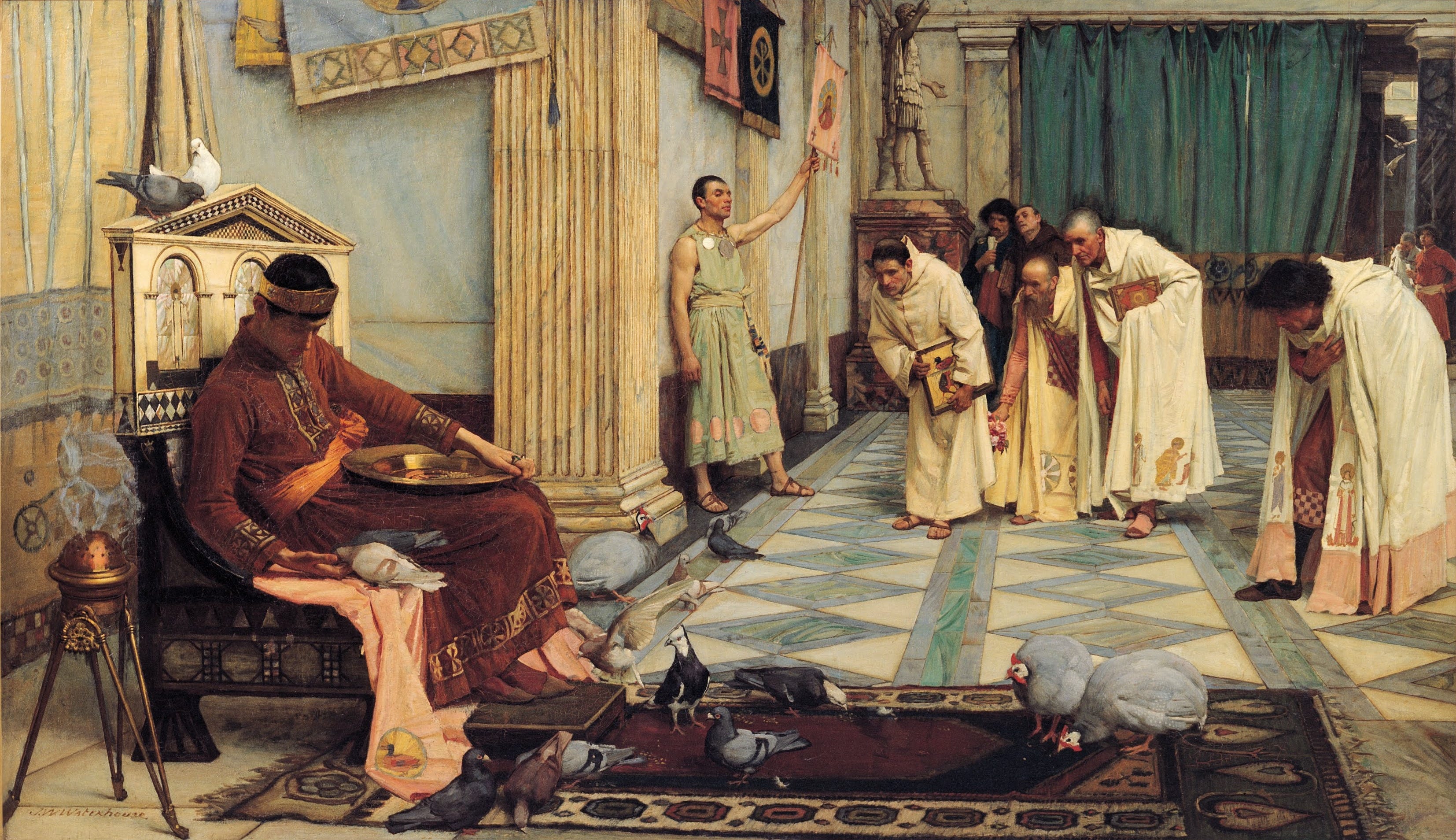
Pelagius, a monk and theologian who lived in Rome at the time, reached a radically different conclusion. Appalled by the moral decay of Christian elites, he attacked Augustine’s doctrine of moral inability, the belief that original sin had so corrupted human nature that people became incapable of independently choosing good. Augustine famously expressed this in prayer: “Grant what Thou commandest, and command what Thou wilt.”
Pelagius countered: Telling Christians they were fundamentally powerless until God’s grace fixed their souls would only invite moral laziness. To Pelagius, the remedy for failure was simple: God already gave humans free will. Being moral requires only exercising that will and making better decisions.
“Everything good and everything evil… is done by us, not born with us. We are not born in our full development, but with a capacity for good and evil.” (quoted in Augustine, On Original Sin 2.14)
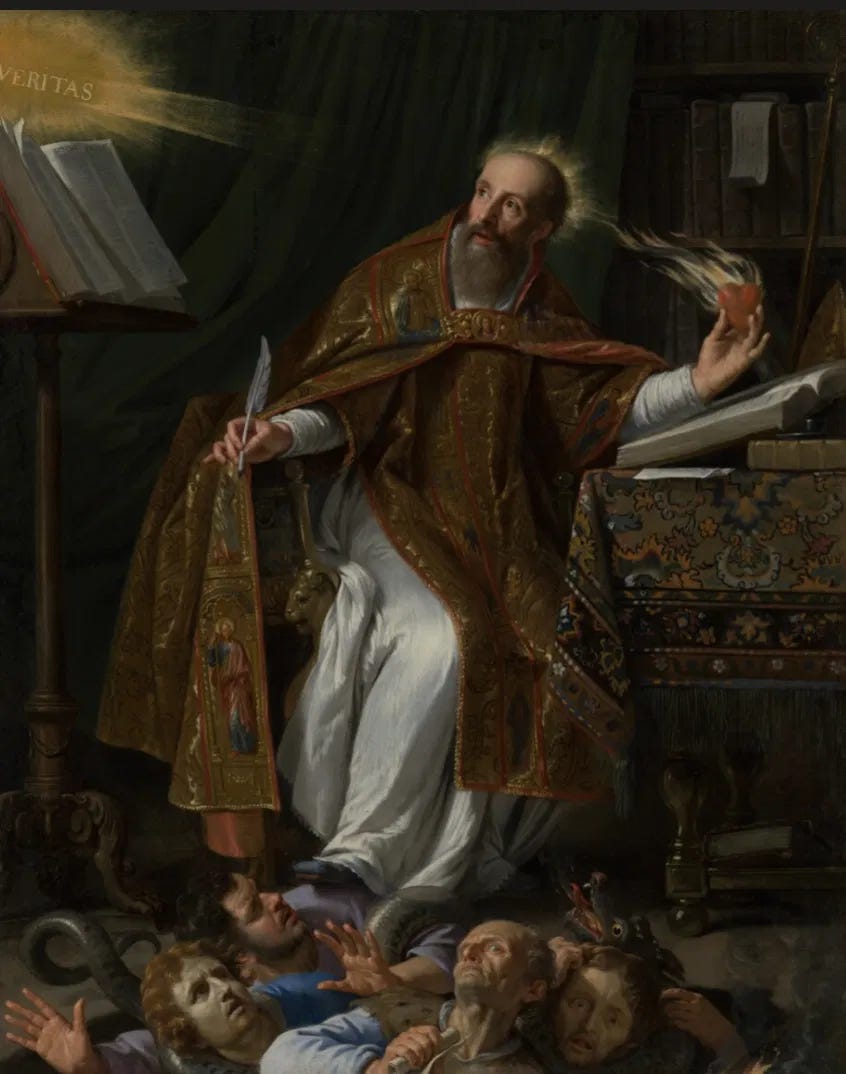
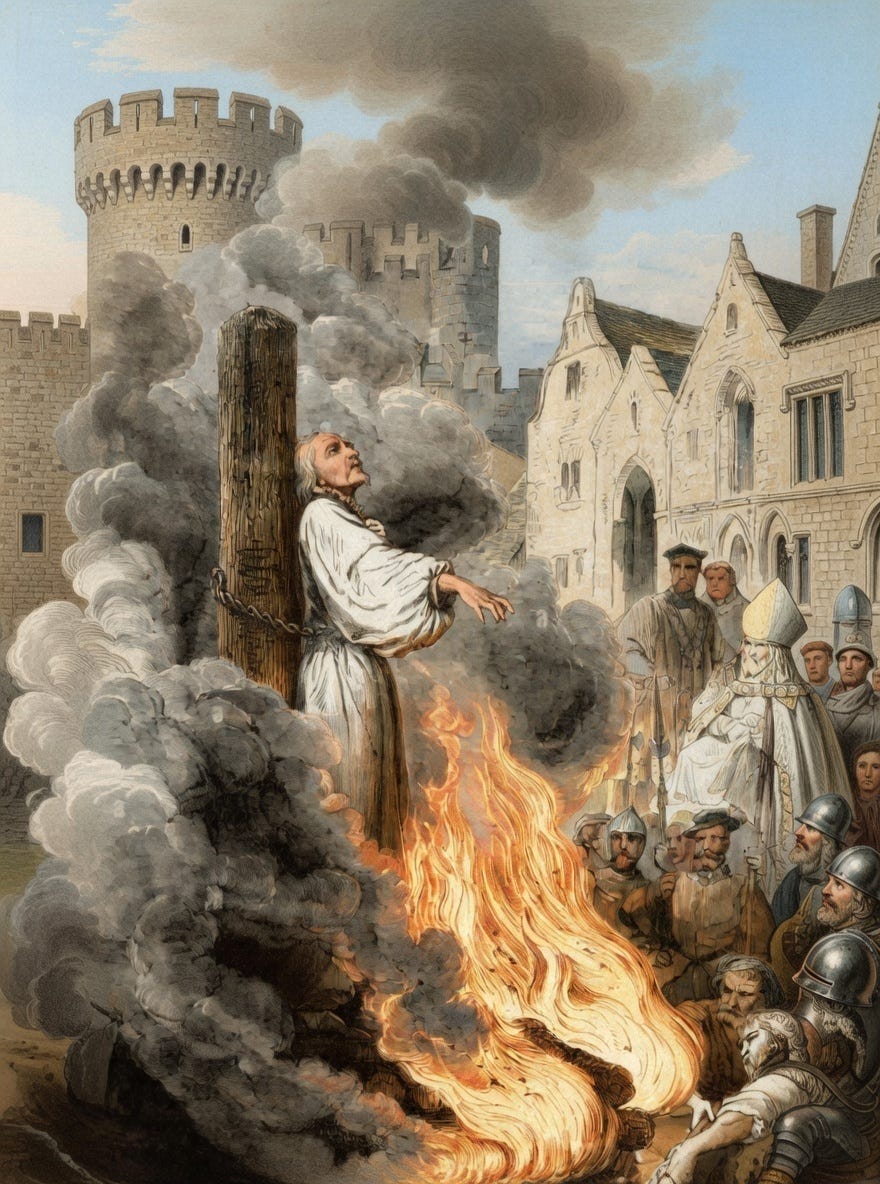
Augustine eventually won this theological battle. Pelagius was exiled. His followers were condemned as heretics. The idea of human reason autonomous from God became the church’s number-one enemy. The Christian church didn’t just argue with those who trusted human intellect. Over the next thousand years, it annihilated them. This institution, supposedly guided by God, birthed the Inquisition to torture the masses into submission and demanded the church’s interpretation of scripture over individual reason. It burned reformers alive, as with Jan Hus in 1415, who had dared to suggest a man’s conscience could challenge religious authority. It strangled William Tyndale in 1536 simply for translating the Bible so the poor could read and interpret it for themselves.
Augustine wasn’t always this man. Early on, he defended free will. He wrote that all people “are to be loved equally.” That Augustine sounds a lot like Jesus. Then something shifted. Late in life, he admitted it himself: “I labored for the free choice of the human will, but the grace of God conquered.” The Augustine who came after is the one Hegseth’s worldview comes from.
Kurt Flasch, a historian of medieval philosophy at Ruhr University Bochum, traces this war on human reason back to 397 AD. That year Augustine first called humanity “a single mass of sin,” which only a grace no one can earn could save. Over a thousand years later, Martin Luther and John Calvin, the founders of Protestant Christianity, inherited the idea, and so did the violence. Flasch has a name for it:
The logic of terror.
Calvin saw himself as Augustine’s heir. He quoted him constantly. He took Augustine’s distrust of human reason and turned it into doctrine: the Fall of Man didn’t just corrupt your soul; it corrupted your mind. Your reason cannot be trusted.
In 1553, a Spanish physician, Michael Servetus, came to Geneva to challenge Calvin’s doctrine with reason. Calvin lobbied for his beheading but Geneva’s city council decided to burn Servetus at the stake.
Five centuries later, Hegseth made a similar Augustinian argument about progressives on a podcast. They cannot fix America because human reason itself cannot fix anything.
“The critical theorists are trying to do the perfection,” he said. “Creating a human utopia by tearing down what existed for the ages, which is based on a lie—because as a Christian, I know that I’m inherently sinful. I can’t be perfected...”
There’s an obvious problem here. Jesus said to turn the other cheek and love your enemies. Are these teachings conducive to building war machines?
Rome hit that wall in the fifth century, when its emperors turned Christian but still needed an army prepared to kill. Augustine solved this with loopholes. When the Roman commander Boniface asked him for spiritual guidance, Augustine replied that a soldier could please God so long as he let “necessity, and not your will, slay the enemy” (Letter 189). He wrote elsewhere that killing isn’t the sin. Only the hatred behind it is (Contra Faustum 22.74).
Seven centuries later, Pope Urban II took that loophole one step further: killing for God wasn’t just allowed, it would wash away your sins. Tens of thousands marched on the First Crusade, and their battle cry was Deus Vult, “God wills it.” Hegseth has it tattooed on his arm.
This is the same loophole Hegseth needs on December 3rd. The state kills not out of hatred, only necessity. Augustine also explained what fear is for. He wrote that it is “so useful” that whole cities “became Catholic under the influence of that fear.” He insisted that forcing Christianity is an act of love: “compel them to come in.”

Battle for the American Mind: Hegseth compels you to come in
In the 20th century, Augustine and Calvin’s distrust of human reason found new life in America. Between 1910 and 1915, conservative Protestants published a series of booklets called The Fundamentals to defend the Bible against modern science and scholarship. The Fundamentalists took evolution to court in the Scopes trial in Dayton, Tennessee, where the national press made them a laughingstock. They pivoted to building their own churches, schools and radio stations, each free of secular humanist concepts.
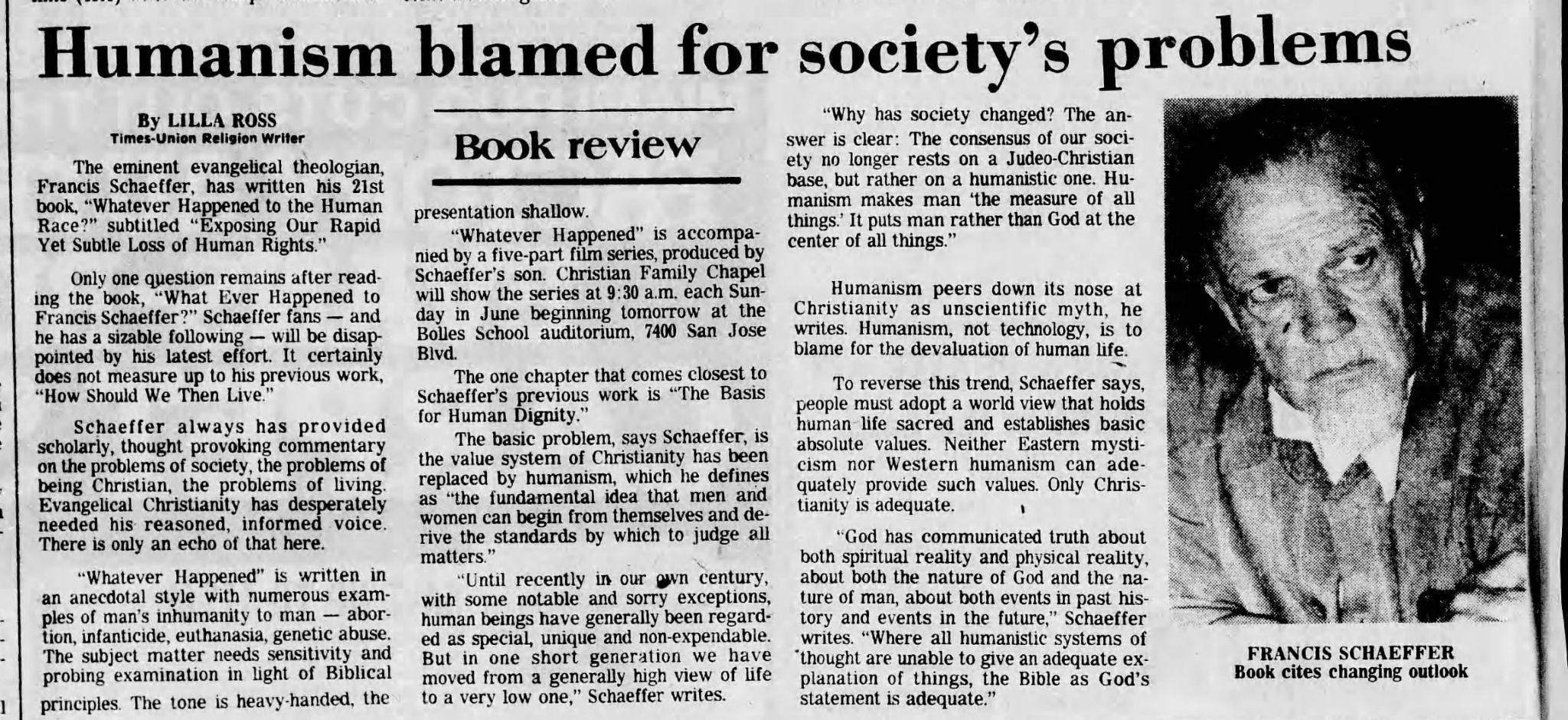
In 1968’s Escape from Reason, the theologian Francis Schaeffer gave the old Augustinian argument a modern update. He claimed to be defending reason, but only reason birthed from Scripture. Science and art must stay under God’s word, he wrote, because “any autonomy is wrong.” Reason that relied on evidence alone was the real escape from reason. That flip gave the movement exactly what it needed. Suddenly, scientists were the irrational ones.
Jerry Falwell applied this idea to politics. He used “humanist” the way a Fox News anchor uses “woke,” as a catch-all for every idea he didn’t like. In 1979 he co-founded the Moral Majority. The next year he warned that America’s children were being “educated in a public-school system that is permeated with secular humanism.” He helped elect Reagan and pushed the pro-life movement into the national spotlight.
In 1980, Tim LaHaye, one of the Moral Majority’s founding directors, wrote The Battle for the Mind and dedicated it to Francis Schaeffer, “the renowned philosopher-prophet of the twentieth century.” “Most of the evils in the world today can be traced to humanism,” LaHaye wrote, and his solution was blunt. “We must remove all humanists from public office.” He knew where he stood in history: “The 1960s saw the battle for racial rights. In the 1970s, it was sexual rights. But the 1980s have been designated for the battle against religious rights.”
Pete Hegseth, theologian.
It’s tempting to picture Hegseth as the hard-drinking Fox News blowhard of his critics’ imagination. His books tell a different story. Hegseth knows the history of this argument, and where he stands within it.
In 2022, Hegseth with David Goodwin published Battle for the American Mind, a title that echoes LaHaye’s The Battle for the Mind. Its footnotes run from Clement of Alexandria and Justin Martyr to Augustine. And the last name on the list of prophets who warned America is Francis Schaeffer, who “said we had ‘escaped from reason’ (1968).”
Schaeffer is the vessel he uses to retell the history of American Christianity. Citing Schaeffer’s “Faith vs. Reason divide,” he traces the church’s downfall to the late 1800s, when it split in two. One side was the Social Gospel, the movement that taught Christians to fight poverty and injustice. In Hegseth’s telling, it “left the Christian tradition behind in its pursuit of labor laws, temperance, women’s rights, and other social activism,” and folded “Marxism into ‘justice.’”
Social Gospel is the Christian tradition that helped give America the New Deal and the Voting Rights Act. Hegseth employs Schaeffer to attack the Christianity in soup kitchens, labor laws and the march on Selma, ideas inspired by Jesus’s work on earth (you know, feeding the hungry, freeing the oppressed, healing the sick), Christian activism that saw little to fear in science. As King wrote, “Science gives man knowledge which is power; religion gives man wisdom which is control.”
Hegseth’s weapon against this humanism comes from Augustine’s concept of the ordering of loves, or ordo amoris. Hegseth calls it “the real breakthrough idea,” a view “from 400 AD” that “defined the social and religious economy of the Western Christian world.” When Jesus said to love your neighbor, Hegseth said, what he meant was that love is ranked. Your neighbor isn’t at the top: “If loving one’s neighbor supersedes loving God in some way, then loving thy neighbor is not properly ordered.”
Feeding the poor is good, he wrote, “but the greater good is that Jesus is worshipped.” And then he follows his own logic. “Even lies or not feeding the poor can be virtuous, when they are ordered against other affections.”
Yes, Hegseth really believes lying and letting the poor starve can be Christian virtues, so long as they serve a higher love. By his logic, bombing a girls’ school in Iran and killing 120 children can be justified.
JD Vance used this same idea in 2025 to defend mass deportations: “You love your family, and then you love your neighbor, and then you love your community.” Pope Francis answered him: the true ordo amoris is that of the Good Samaritan, a love “open to all, without exception.”
The Pope lost that argument. Ordo amoris has since become a rallying cry for Christian nationalists who rage from the pulpit to podcasts and use the theology to punish immigrants.
Butchered to make a Roman holiday
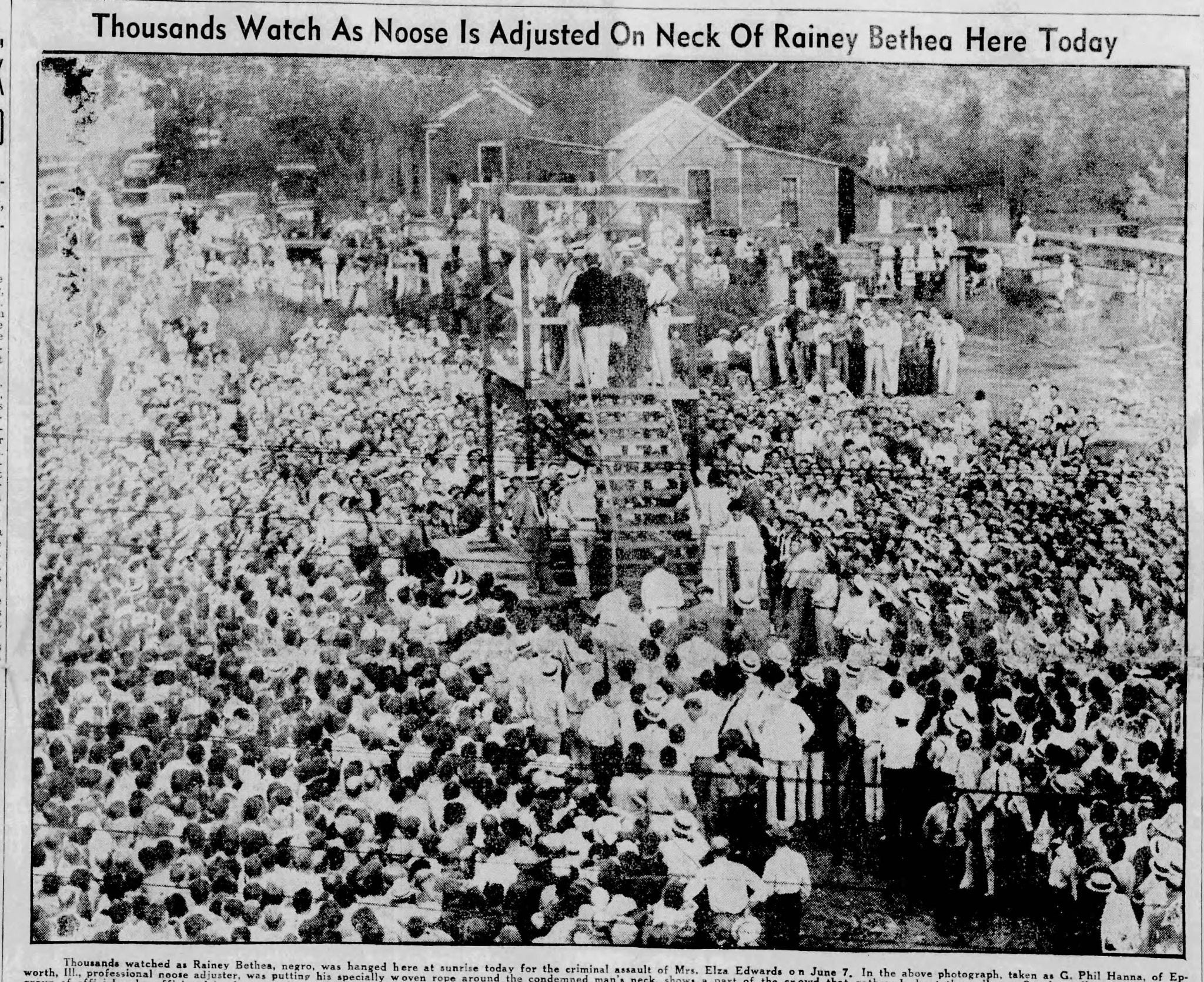
America’s last public execution was in 1936, when Rainey Bethea, a young Black man, was hanged in Kentucky before thousands of onlookers. Souvenir hunters where said to have torn the hood off his head before he was dead. Newspapers called it a “carnival of sadism.” A local sheriff disagreed: “The publicker the better.”
Hegseth agrees with the sheriff.
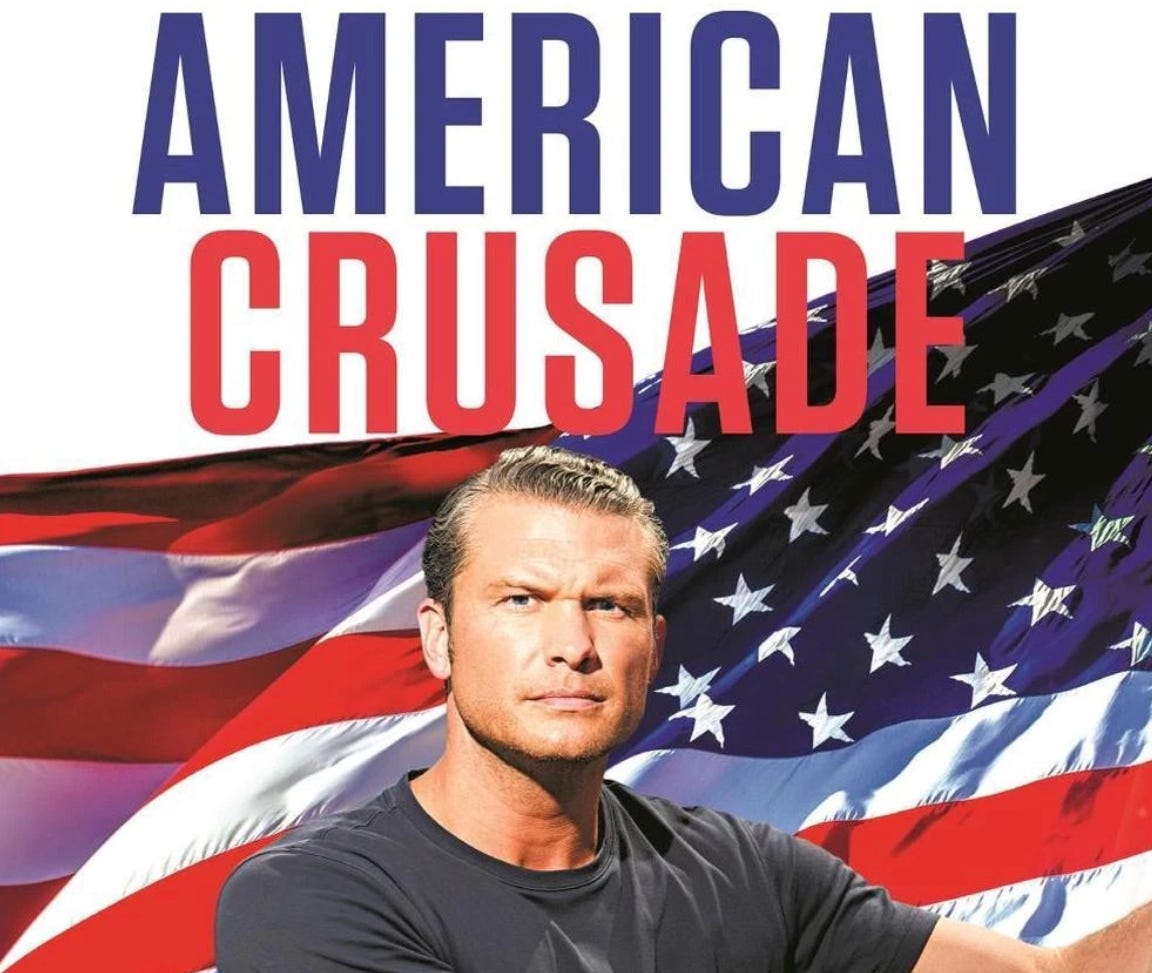
To Hegseth, it barely matters who’s in front of the firing squad. Hasan is just the easiest man in America to kill, and it helps that he’s Muslim. In Hegseth’s world, leftism is Islam without the mosque. “You are an ‘infidel,’” he tells Christian readers in American Crusade, “according to the false religion of leftism. You are marked for annihilation. Just like Islamism, you can submit now or later; or you can fight” (p. 289).
The real target is everyone watching. Augustine said fear converts whole cities. A livestream puts that fear in every home in the country. And if you object? Hegseth’s answer is ready: are you going to defend a jihadist who killed a dozen soldiers?
Calvin made the same move in 1554:
“Whoever shall now contend that it is unjust to put heretics and blasphemers to death will knowingly and willingly incur their very guilt.” - John Calvin, Defensio orthodoxae fidei (1554)
The Crusade Comes Home
In his 2020 book American Crusade, Hegseth wrote:
Our American Crusade is not about literal swords, and our fight is not with guns. Yet. … Yes, voting is a weapon, but it’s not enough. We cannot outsource or delegate our crusade. Arm yourself—metaphorically, intellectually, and physically.(pp. 293-294)
When leaders like Hegseth view the Constitution merely as a means to an end for a Christian state, the definition of an enemy inevitably expands. Today, it is a convicted mass shooter facing a firing squad. Tomorrow, when the state is tasked with purging the blasphemy of secular humanism from our culture and institutions, who protects the teacher, the journalist, the dissenter, or the American who simply believes that logic and evidence should govern a free society?
These guys aren’t stupid. They are brilliantly, ruthlessly deliberate. They know precisely how to test for weaknesses in the constitutional principles they are trying to knock down. When Hegseth looks at a public school classroom, a military base, or a courtroom, he does not see a democratic institution. He sees a battleground where God has been removed, and he is signaling that he is more than willing to use violence to put Him back.
When someone tells you they are fighting a holy war, and they show you the weapons, the theology, and the firing squads they are willing to unleash, you should believe them.
So what do you do? Let’s start by clearing up the misconceptions:
Hegseth isn’t dumb or crazy. Dismissing this movement as merely unhinged ignores how methodically it has built power from the Pentagon down to local school boards.
This isn’t unprecedented. We are living through a modern chapter of a 1,600-year-old debate, using the same Augustinian-Calvinist machinery that built the Inquisition, burned reformers alive, and justified absolute state control over human reason.
He isn’t a follower of Jesus. A movement obsessed with lethal military force, the purge of dissenters, and state-enforced religious orthodoxy has little to do with being Christian.
Democracy still matters. Voting is the most crucial tool we have to end the crusade Hegseth and company have started. Protecting reason, pluralism, and free thought requires treating this political threat with the serious urgency it demands because a state that punishes humanism can also burn us at the stake.
P.S. Augustine’s defenders like to point out that he never burned a heretic. True. He just wrote the instructions. Fear is “useful,” he said. Force is love: “compel them to come in.” He even defended the judge who tortures innocent people, calling it a sad necessity, and prayed to be delivered from his “necessities.” Then he left the matches for the Inquisition.