


Pope Leo condemned the attack on Iran as immoral, accurately citing Jesus's teaching on pacifism to do it. Trump then called Leo “terrible for foreign policy.” Vance told him to “stick to matters of morality.” And Sean Hannity followed announcing he was leaving the Catholic Church over this, “continued corruption” and asks the Pope: “Have you even read the Bible?”
Mark Levin, host of the Fox News show, Life, Liberty & Levin, jumped on the bandwagon of Fox News commenters and Christian nationalists attacking the Pope. We are used to hearing commentators become instant experts in virology to counter Covid science, atmospheric physics to counter climate change, or election law to propel myths of widespread voter fraud. But this specific way of undermining theology is more dangerous, because what is at stake is reason itself — the way we come upon and agree on all truths.
On April 19th Levin starts his program with “As you know, there’s been a lot of discussion about theology and this war.” Levin, who frequently evokes his Judaism for political commentary, says he “doesn’t pretend to be a theologian or a scholar.” But this won’t stop him from becoming an authority on Catholicism.
He sets up his argument by reading the Pope’s Easter address:
“Brothers and sisters, this is our God, Jesus king of peace who rejects war, who no one can use to justify war. He said he does not listen to the prayers of those who wage war, but rejects them saying, ‘Even though you make many prayers, I will not listen. Your hands are full of blood.’”
Levin reacts: “Wow, that’s pretty pacifistic!... What is a just war?”
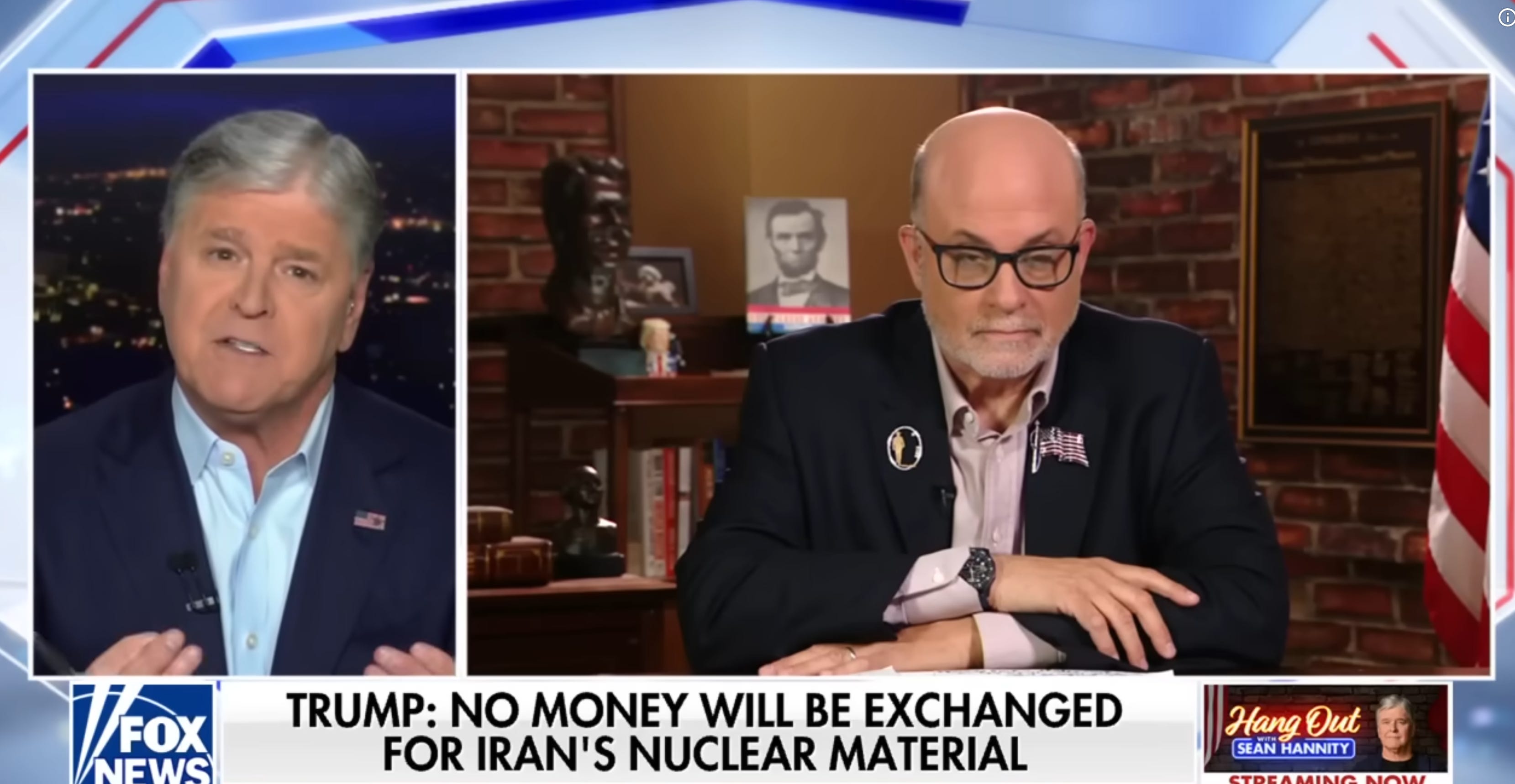
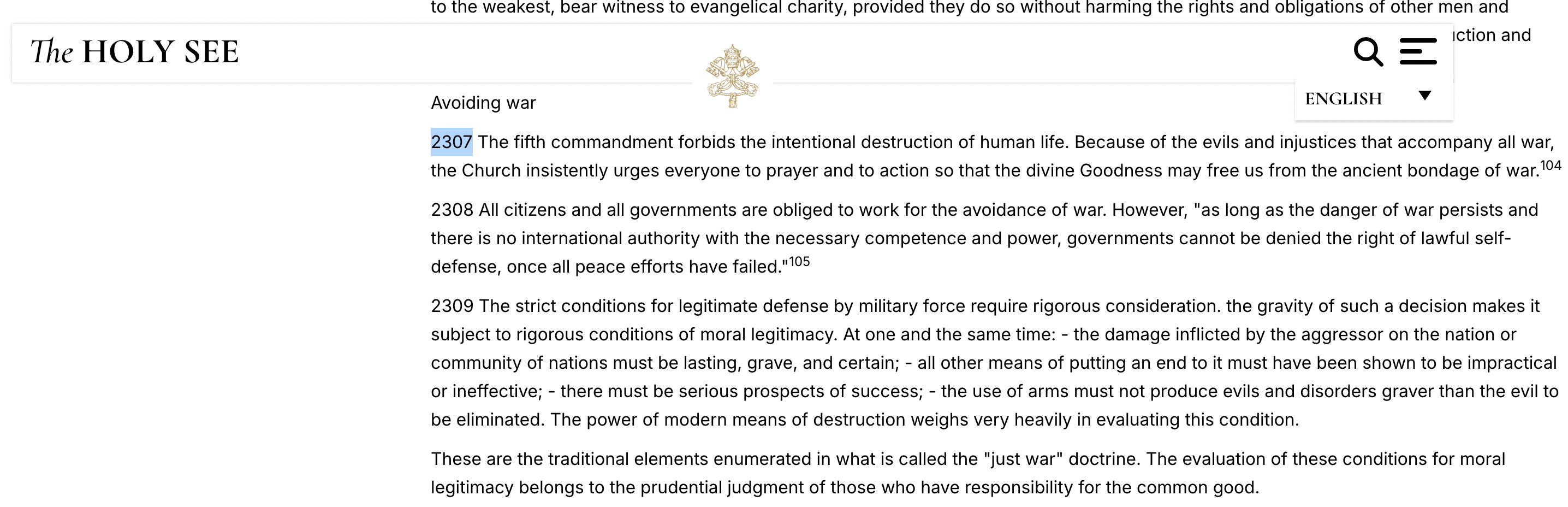
The tool he uses to dismantle the Pope’s interpretation of Jesus is the Catechism, a compendium of Catholic Church doctrine. Levin leans hard into passages of Just War theology: “In paragraph 2309, the damage inflicted by the aggressor on the nation or community of nations must be lasting, grave and certain. All other means of putting an end to it must have been shown to be impracticable and ineffective. There must be serious prospects of success and the use of arms must not produce evils and disorders graver than the evil to be eliminated.”
Eureka. Levin declares: “Well, this is a just war then by this definition.” The attacks on Iran are Jesus-approved. The Pope simply hadn’t done his homework.
What he doesn’t tell you is that the just war tradition he was citing was not derived from Jesus, and not written solely by Aquinas. Christian just war theology was invented, largely, by Augustine of Hippo in the early fifth century, specifically to solve a political problem that Jesus himself never had: how to run an empire.
Levin’s first draft is 1600 years old
After the Sack of Rome in 410 by the Visigoths, the Empire was in shock. Military leaders were questioning whether a religion based on non-violence — “turn the other cheek” — would give them the theological permission they needed to crush their enemies, an important requirement for empire building. They had moved from worshiping the all-powerful Mars, an actual God of War who did not mince words:
“If you command me to bury my blade in my brother’s breast, in my father’s throat, in my wife’s pregnant body, I will do all.”
- Mars (Lucan’s Pharsalia, 1st century CE)
Compare to Jesus: “A new commandment I give to you, that you love one another: just as I have loved you, you also are to love one another.” -
Jesus (John 13:34-35)
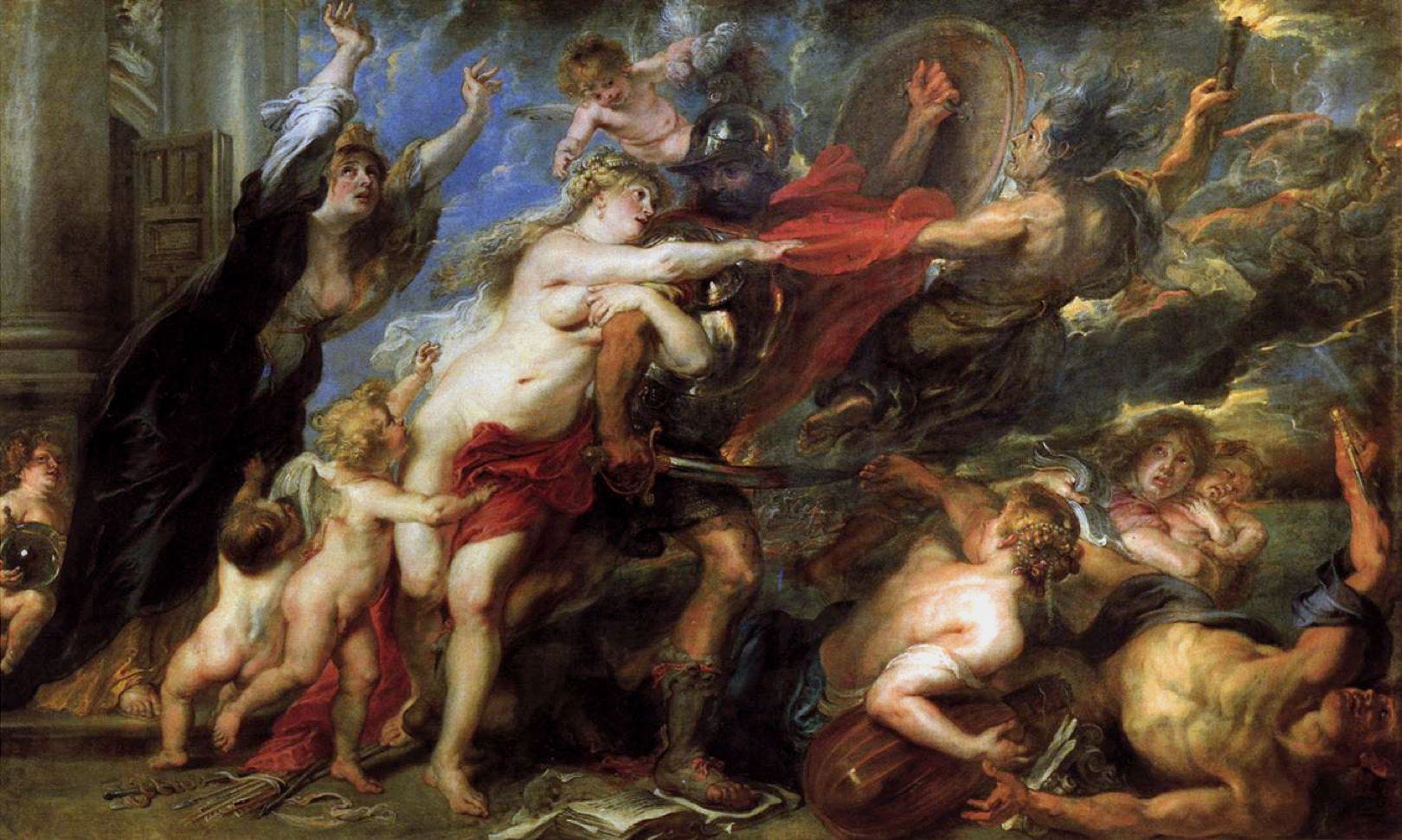
Roman military commanders like Boniface were having a hard time with the tradeoff. He wrote to Augustine asking whether a Christian soldier could kill without sin. In Augustine’s response we can see the early revisioning of Jesus the pacifist into Jesus the god of war. It’s the first draft of everything Levin read on air last week.
He told Boniface not to worry. War is not incompatible with Christian love, Augustine explained, as long as it is waged by legitimate authority, for a just cause, with the right intention. The soldier who kills on orders is not a murderer. The violence is the state’s, not his. His soul is clean. And fortunately for Boniface, Augustine, as a head of the Church, could sanctify his wars. Problem solved. He wrote:
“Do not think that it is impossible for any one to please God while engaged in active military service. Let necessity, therefore, and not your will, slay the enemy who fights against you.”
Augustine solidifies his just war framework a few years later in City of God:
“But, say they, the wise man will wage just wars. As if he would not all the rather lament the necessity of just wars, if he remembers that he is a man… For it is the wrongdoing of the opposing party which compels the wise man to wage just wars; and this wrong-doing, even though it gave rise to no war, would still be matter of grief to man because it is man’s wrong-doing… And if any one either endures or thinks of them without mental pain, this is a more miserable plight still, for he thinks himself happy because he has lost human feeling.”
The wise man is justified in waging war as long as he feels bad about it. To wage war without mental pain is a sin. You don’t need to read very much of the Sermon on the Mount to know Jesus never said anything close to this.
But here we are 1,600 years later believing Jesus was pro-war, when the idea has nothing to do with Jesus at all. It actually predates Augustine by 350 years. Cicero first laid out the just war framework in De Re Publica — a set of boundaries for engaging in war, a proto-UN Charter. Entirely secular, built on ethical reasoning accessible to any rational person regardless of faith. No God or scripture required. Just reason.
Augustine took Cicero’s framework, stripped out the reason, and replaced it with scripture. And when scripture didn’t deliver the conclusion the empire needed, he adjusted his interpretation until it did. That is what Mark Levin read.
Why does the war have to be Holy?
Because Cicero’s framework has a fatal flaw — it’s democratic. Anyone can apply it. The enemy can invoke the same criteria and argue their case. The framework is neutral. It can go against you.
Augustine fixes that. Once you replace reason with scripture and make the Church the sole arbiter, you’re no longer fighting for Rome. You’re fighting for God. And fighting for God solves the one problem Cicero never could — it cleans the soldier’s soul. Under Cicero, a just war is a legal decision. Augustine turns it into a ceremony. The killing isn’t sinful as long as your heart is in the right place and you feel bad about it.
Which is the most useful thing an empire has ever been told.
Levin says of the Iranians: “They live to kill. Jihadis, kill as many people as you can, anybody who disagrees.” Under Cicero’s framework, an Iranian counter-attack is a logical step. A people defending themselves against a foreign military strike have just cause. The criteria are neutral and apply to both sides. Cicero doesn’t care which god you pray to.
But Levin needs Augustine precisely because Augustine lets him disqualify their god. Once you replace neutral reason with Christian scripture and make the Church the sole arbiter of legitimate authority, the enemy’s claim evaporates. They didn’t choose the right god, so their just cause ain’t just — not because the facts don’t support it, but because their authority isn’t legitimate. And legitimate means the right kind of Christian.
That is where Levin is simply wrong.
Beyond the technical misreading, none of the church fathers — not Augustine, not Aquinas — treated just war as a checklist for going to war the way Levin does. The entire tradition was built around restraint. The conditions weren’t a to-do list before battle. The question the tradition asked was never can we find justification for this war we’ve already decided to fight. It was, have we exhausted every reason not to fight?
Here is where he is dishonest.
Levin spends considerable time on Catechism 2308 and 2309 — the passages listing the conditions for justified war. But he skips what comes immediately before, paragraph 2307, which is the actual point:
“The fifth commandment forbids the intentional destruction of human life. Because of the evils and injustices that accompany all war, the Church insistently urges everyone to prayer and to action so that the divine Goodness may free us from the ancient bondage of war.”
This is the Catechism’s predicate and everything that follows are the exceptions. He read the fine print but not the actual text. The section is titled “Avoiding War.” He didn’t skip 2307 by accident. 2307 is the Pope’s entire argument.
So why now the hysteria over a Pope? Why the crash courses in Catholic theology? Why is Hannity quitting a church he’s belonged to his whole life rather than simply disagreeing with its leader? Why is the Vice President of the United States telling the Pope to be careful?
The lady doth protest too much.
Because if the Pope is right and by every measure he is, the war is conclusively unjust. Not just by Leo’s reading of scripture. By Aquinas’s criteria, which require that the sole intention be peace, not domination. By Cicero’s secular framework, which applies the same neutral standard to both sides and doesn’t care which god you pray to. And by the Catechism Levin himself read on air, whose very first sentence on the subject forbids the intentional destruction of human life and urges “freedom from the ancient bondage of war”.
Every framework they invoked to justify this war condemns it.
But this doesn’t answer my earlier question. Why does the war need to be sanctified? Why do they all care what the Pope thinks? Why can’t it just be justified on secular grounds, United States policy, national interest?
Because it probably can’t. Over 100 international law experts agree. A war that holds up to rational secular scrutiny doesn’t need Augustine. It doesn’t need Levin reading the Catechism on prime time television. It doesn’t need Hannity quitting the Catholic Church. It doesn’t need the Vice President warning the Pope to watch his mouth.
They need to sideline reason because the justification won’t survive it. And that is the Augustinian trap in its purest form — replace reason with religious authority, always redirect back to a holy text, declare that only the right kind of Christians can determine what is true, and you’ll never be wrong.
The irony is almost too perfect. The one person standing between Trump, Vance, Fox News and the truth they’re trying to bury is the head of the Augustinian order.
What separates Leo from Levin isn’t that Leo rejects Augustine. It’s that Leo reads him whole — cross-referencing Augustine against Christ, which is what Augustine himself demanded. The parts Vance and Levin reach for are precisely the parts where Augustine was most compromised — serving an empire that had killed his savior, bending theology to justify whatever the state required.
Augustine knew what he was doing. The grief he required from soldiers as a condition of Just War was his own penance for recommending it to Boniface.
The United States can still choose reason. That's what the Pope is saying. That's what all the attacks on him are trying to drown out.
____________________________
Primary Sources
Augustine of Hippo, Letter 189 to Boniface (c. 417 AD). Full text: https://www.newadvent.org/fathers/1102189.htm
Augustine of Hippo, Contra Faustum Manichaeum, Book 22, sections 69–76 (c. 400–410 AD). Full text: https://www.newadvent.org/fathers/140622.htm
Augustine of Hippo, City of God, Book XIX, Chapter 7. Full text: https://www.newadvent.org/fathers/120119.htm
Cicero, De Re Publica (54–51 BC). Just war framework.
Lucan, Pharsalia, Book 1 (1st century CE). Mars quote.
Thomas Aquinas, Summa Theologica, II-II, Question 40. Just war criteria. Question 64, Article 7. Double effect doctrine.
Catechism of the Catholic Church, paragraphs 2263, 2264, 2265, 2266, 2307, 2308, 2309, 2310 (1992). Full text:
https://www.vatican.va
Mark Levin Transcript
Mark Levin, Life, Liberty & Levin, Fox News, April 19, 2026. Rev transcript: https://www.rev.com/app/transcript/NjllOWUwZmYxYWFiMDAwN2IzNzEwMzY2NkhDVWh4QlBWSHNX/o/VEMwNTY3NTAwNTc1
Pope Leo XIV
Pope Leo XIV, Palm Sunday address, March 29, 2026. Cited in multiple sources including: https://www.newsweek.com/how-war-of-words-donald-trump-making-pope-leo-xiv-11860046
Pope Leo XIV biographical background — Augustinian order, doctoral thesis, seminary teaching: https://www.northeastern.edu/2026/04/23/pope-leo-xiv-political/
Trump Administration Responses to Pope Leo
NPR, “Pope Leo vs. The Trump Administration,” April 16, 2026: https://www.npr.org/2026/04/16/nx-s1-5787533/pope-leo-vs-the-trump-administration
ABC News/Newsbusters transcript, Vance vs. Pope Leo, April 15–16, 2026: https://newsbusters.org/blogs/nb/jorge-bonilla/2026/04/15/shameless-abc-continues-pretend-care-about-what-catholics-think
Newsweek, “How a War of Words With Donald Trump Has Been the Making of Pope Leo XIV,” April 22, 2026: https://www.newsweek.com/how-war-of-words-donald-trump-making-pope-leo-xiv-11860046
Northeastern University, “What is the Political Role of Pope Leo XIV Amid Trump Feud,” April 23, 2026: https://news.northeastern.edu/2026/04/23/pope-leo-xiv-political/
Fox News Theological Counter-Offensive
National Catholic Register, “Does Pope Leo Reject Just-War Teaching? Theologians Push Back,” April 20, 2026: https://www.ncregister.com/news/pope-leo-and-just-war-teaching
Father Gerald Murray, Raymond Arroyo, Robert Royal — Fox News “The Prayerful Posse” segment, April 2026. Cited in ncregister.com piece above.
Sean Hannity departure from Catholic Church — cited in Newsweek piece above.
John Hagee sermon, March 1, 2026 — cited in earlier search results.
Historical/Scholarly Context
Philip Schaff, ed., Nicene and Post-Nicene Fathers, First Series, Vol. 4 — Augustine’s writings against the Manicheans. https://ccel.org/ccel/schaff/npnf104
Catechism of Trent / Roman Catechism (1566) — predecessor to 1992 Catechism.
Vatican II, Gaudium et Spes (1965) — source of Catechism 2308 language on self-defense.