As the United States cozies upto Christian nationalism once again, further eroding democracy in the name of the Lord, we should not forget that Christianity once saved democracy. The Civil Rights movement was built in churches, by evangelical ministers, and grounded in a spiritual morality.
How did we get from thoughtful religious leaders challenging America’s conscience to watching the Secretary of War, Pete Hegseth, follow a prayer for unity with the statement: “The military slogan ‘our diversity is our strength’ is the dumbest phrase on planet Earth”?
The Theology Behind a Blockbuster
Thisdrive for purity and homogeneity – the idea that the nation’s integrity demands the expulsion of a supposed “enemy within” – is the ancient ghost of Augustine (the same ghost we explored in Part I). It’s the manifestation of the logic that demandsthat only when the moral compass is universally corrected can the city stand. Augustine was not writing about a modern nation-state, but his rejection of secular law as legitimate laid the groundwork for what would later become Christian nationalism.
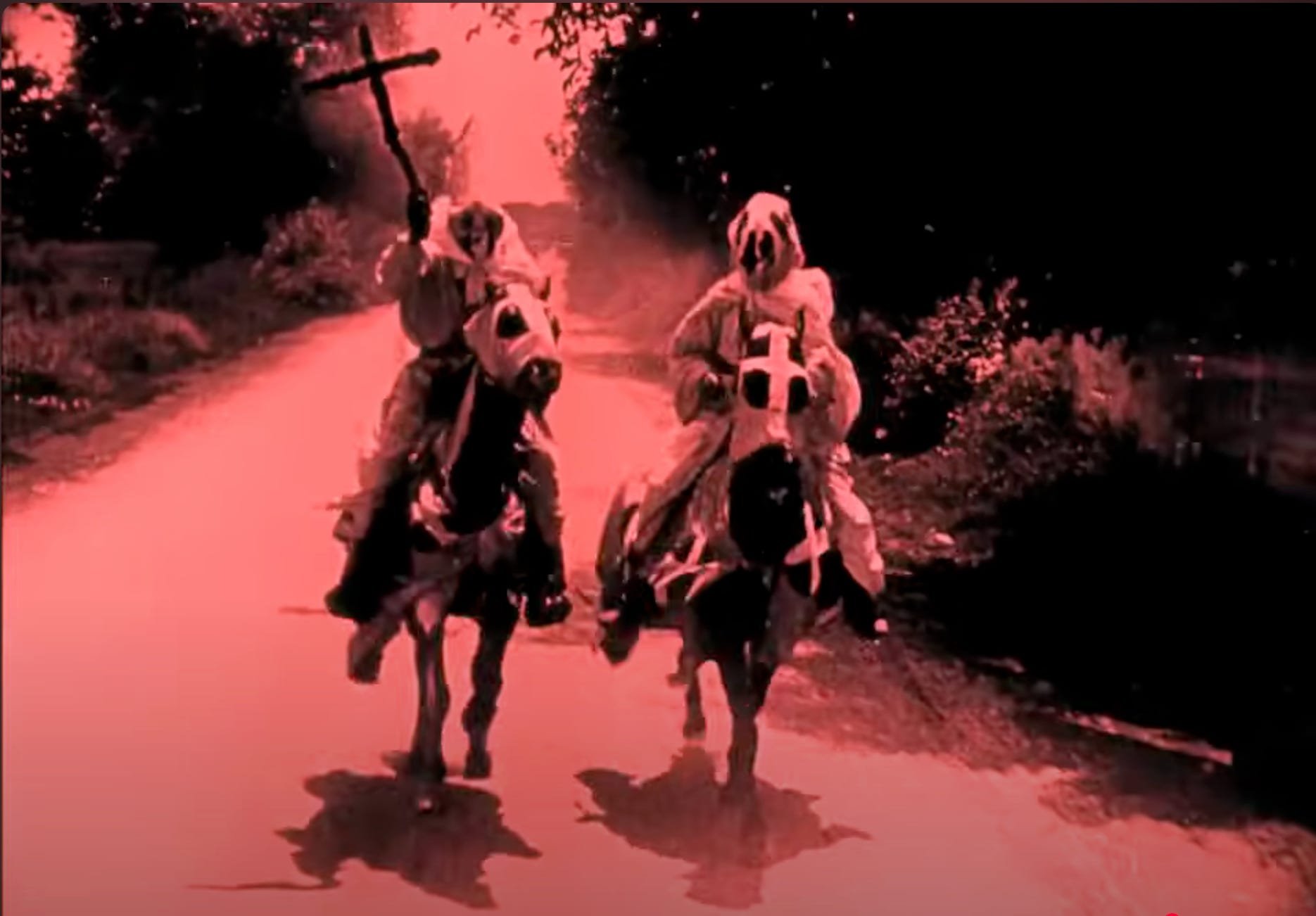
America’s first Hollywood blockbuster transformed the country. D.W. Griffith’s 1915 epic The Birth of a Nation, based on the novel The Clansman, is an imaginary revenge tale in which the Ku Klux Klan ends post-Civil War multiculturalism by intimidating andkilling Black voters. The film concludes with a symbolic “reunion” of a Southern man marrying a northern bride. It is a new, whites-only union, complete with an apparition of Jesus Christblessingthe celebration.
One of the film’s darkest legacies is the introduction of the burning cross as a racial symbol. In its climactic scene, Klansmen lynch a Black man amid a flaming cross. (The burning cross, until Griffith’s The Birth of a Nation, was devoid of racial connotations and existed only as a Scottish highland signal to call clans together.) But this thrilling image ignited a new era of racial terror and sent a message that America is the White Man’s land of their God and country. This ritual of murder served not only to terrorize a population, but to homogenize the entire nation into their whites-only brand of Christianity.
The Ku Klux Klan portrayed as a holy force in The Birth of a Nation (1915), introducing the burning cross as a tool for racial terror.
The Split at Princeton
The Birth of a Nation radicalized audiences through spectacle. But it was Princeton Theological Seminary that paved the way forthe intellectual discourse of Christian nationalism we’re facing today. This was no fringe institution. The school was a leading authority on Protestant theology in America when Protestants were 65% of the country’s population. Princeton produced some of the most influential clergy of its time. And so it remains.
The seminary had been home to theologians like Charles Hodge, who, during the era of slavery, provided moral and theological permission for white Southerners to continue their slaveholding economies by declaring that “slavery is not sinful in itself.” Among the faculty was Joseph Wilson, whose son Woodrow later became President and screened The Birth of a Nation at the White House. The worldview that made that film possible had already been preached on the grounds of Princeton Seminary.
Another supposed threat to Christian civilization was science. In 1912, the conflict between science and religion was heating up as Darwin’s evolutionary theories began expanding throughout America’s public schools. One seminary theologian tried to de-escalate the tensions.
“I do not think that there is any general statement in the Bible or any part of the account of creation… that need be opposed to evolution.”
But not everyone could tolerate coexistence, and the idea that evolution and faith could be taught together caused a revolt.
One response was a bombardment of pamphlets. The Fundamentals was financed by brothers Lyman and Milton Stewart, two Presbyterian oil millionaires, who feared that the nation’s seminaries were drifting in the wrong direction. Between 1910 and 1915, they published twelve volumes containing ninety essays, including many by Princeton theologians, that redefined the “fundamentals” of Christianity and took direct aim at evolution.
The Stewart brothers distributed 250,000 complete copies of The Fundamentals free of charge to pastors, missionaries, and churches around the world — a vast propaganda campaign. Out of this media blitz, fundamentalism was born.
Oil capital that helped finance America’s fundamentalist movement
Science and a Referendum on Race
The war of ideas found its battlefield in the Scopes Monkey Trial of 1925. John Scopes, a young high-school teacher in Dayton, Tennessee, was charged with violating a state law that banned the teaching of evolution. Scopes, an activist, had agreed to work with the ACLU to test the law, knowing it would lead to his arrest and trial.
The trial became a national spectacle. Updates were broadcast live on the radio, something unheard of at the time. Both sides brought in their champions. For evolution, Clarence Darrow, the famed attorney who had previously defended labor leaders and radicals. For Creationism, William Jennings Bryan, the former Secretary of State and Christian orator, who was supported intellectually by Princeton Seminary’s J. Gresham Machen.
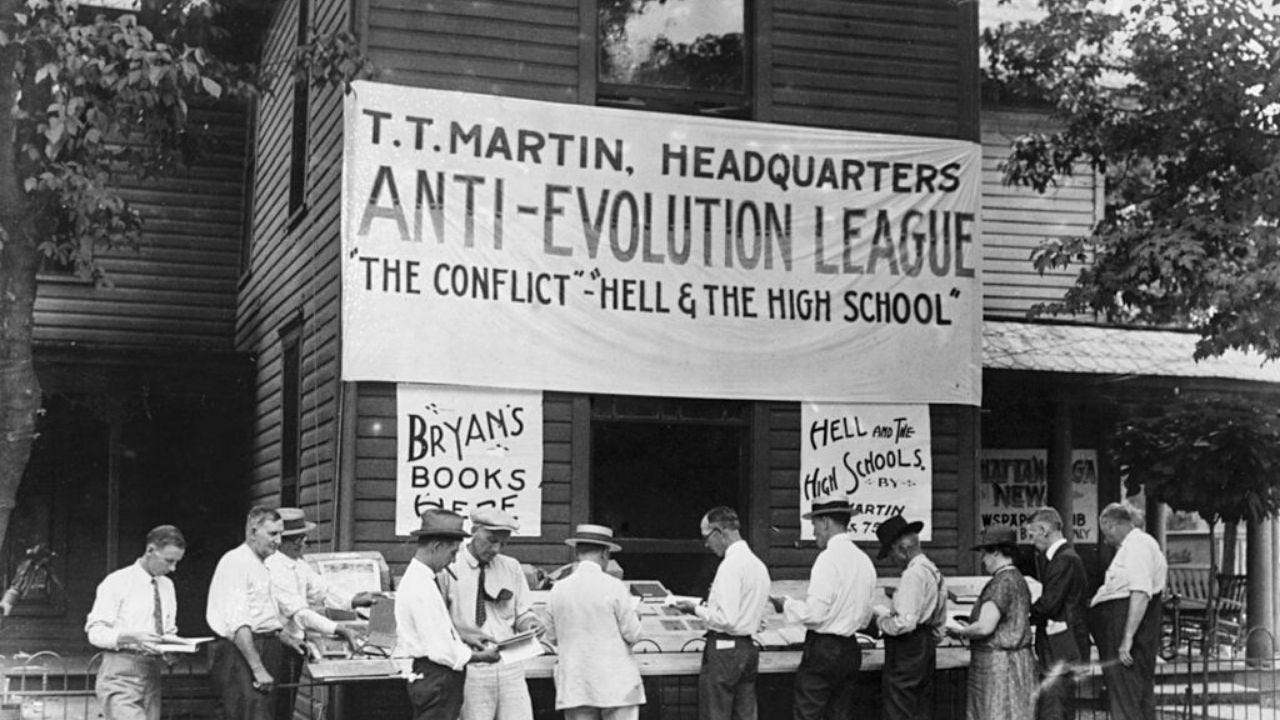
T.T. Martin’s Anti-Evolution League headquarters during the Scopes era.
The creationist cause was humiliated during the public debate. And though Scopes was technically found guilty (Scopes had to pay the minimum fine of $100), the trial marked a cultural turning point. Of the trial, H.L. Mencken for the Baltimore Sun wrote:
“It is not often that a man’s belief in a God can be made to look so cheap and ridiculous before the eyes of all the world.”
Beneath the surface, another battle was being fought — one over race and citizenship. Writer and historian W.E.B. Du Bois, said of the case that: The Scopes trial was not a fight between ignorance and learning, but between two sets of ignorances… Both sides ignored the real question, which is not whether man descended from animals, but that “the Scopes trial has made beasts of men.”
Conservative Christians aligned themselves with creationism not only because of the widely distributed anti-evolution tracts. They also saw it as a theological argument for racial hierarchy.
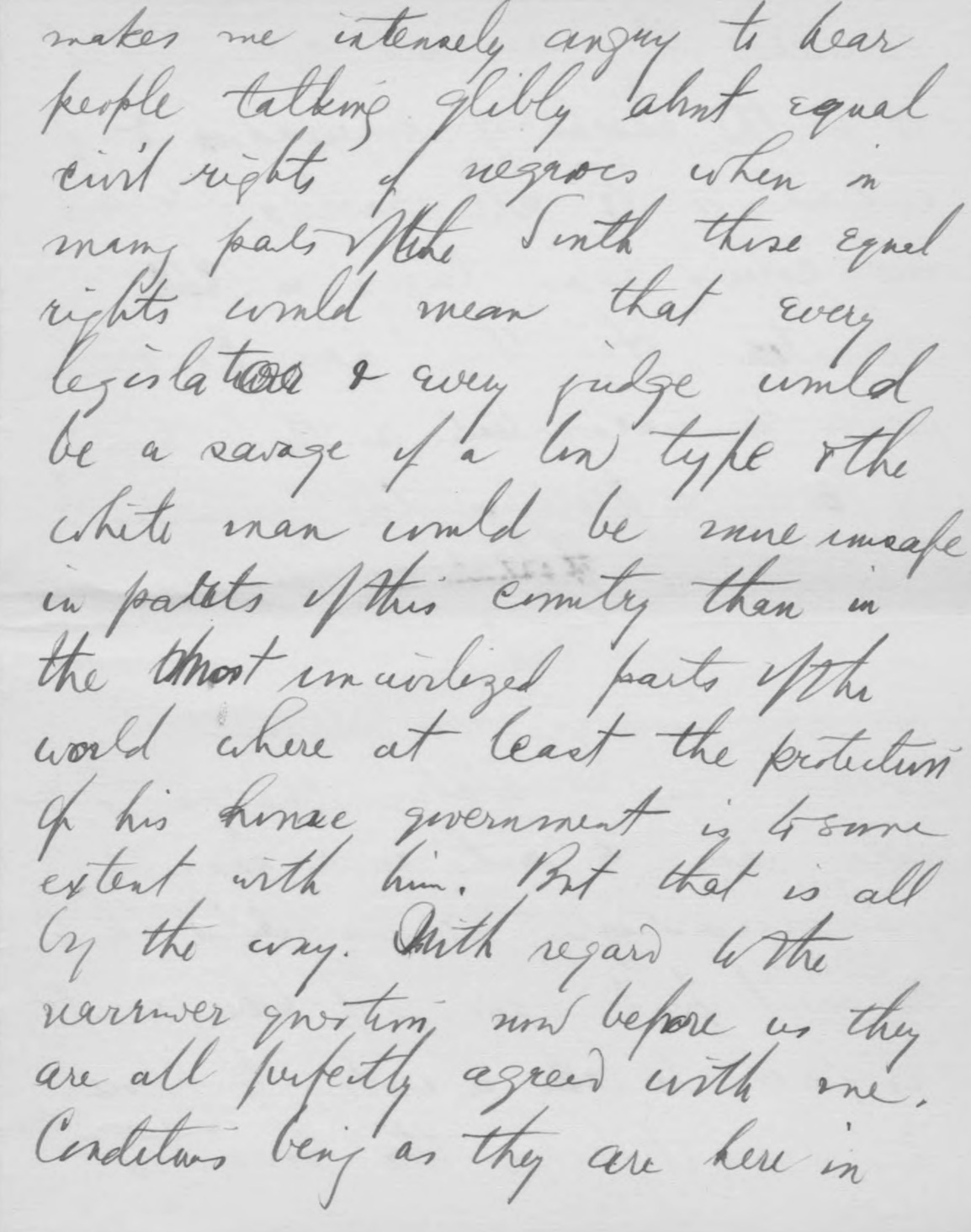
While Machen didn’t speak publicly about race, privately, he seethed. In a letter to his mother, he wrote:
“...makes me intensely angry to hear people talking glibly about equal civil rights of Negroes, when in many parts of the South these equal rights would mean that every legislator and every judge would be a savage of a low type… the white man would be more unsafe in parts of this country than in the most uncivilized parts of the world.”
Machen’s letter to his mother rejecting equal civil rights for Black Americans.
For Black Americans, there was much more at stake than a debate over evolution. The trial became a referendum on education, equality, and who gets to define truth itself. The NAACP and early civil rights organizers understood this well enough and helped shape the public narrative around it.
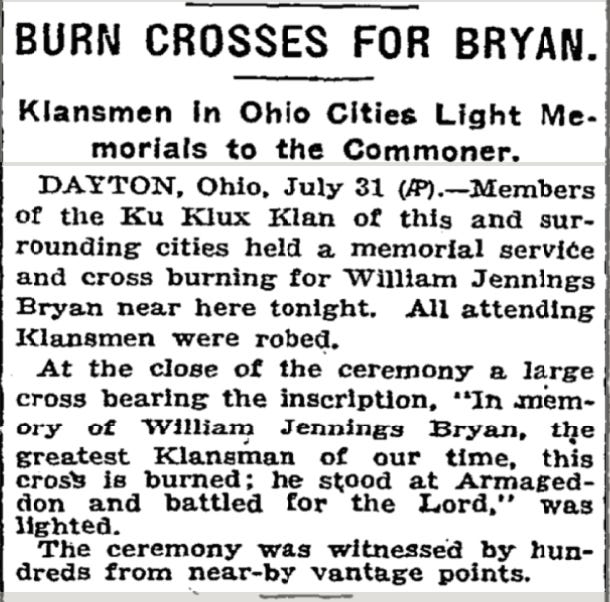
The creationists’ lawyer, William Jennings Bryan, died just days after the trial ended. The New York Times, on July 31, 1925, reported the Ku Klux Klan had a cross-burning ceremony for him:
“In memory of William Jennings Bryan, the greatest Klansman of our time, this cross is burned; he stood at Armageddon and battled for the Lord.”
Although Bryan was not a Klan member, as far as we know, the Klan’s tribute cemented the idea that the fight for the Lord and for a White America was the same battle.
Ku Klux Klan cross burning honoring William Jennings Bryan, July 1925.
The fallout from the Scopes trial accelerated the rift between reason and faith at Princeton Seminary, and fundamentalists read the seminary’s progressive outlook as a sign that their whole framework of truth through scripture was coming apart. So they walked out.
With their leader, J. Gresham Machen, they founded Westminster Theological Seminary, a school built to wage intellectual war in the 20th century. From those halls came a new mission: to reclaim America from “godless education” by fighting public schools that taught science without scripture and framing equality as a rebellion against divine order.
Machen channels Augustine’s ‘enemy within’ logic, explored in Part I, when he wrote: “The greatest menace to the Christian Church today comes not from without, but from within”.
What was this enemy? They attacked Roosevelt’s New Deal as socialism, integration as heresy, and democracy as dangerous if it dared to put Man’s will above God’s law. Westminster became the blueprint for the Christian Right’s long march through American institutions, influencing pastors, politicians, and pundits to preach that scripture must be the controlling authority above laws and the government. Machen’s co-founder wrote, “The state itself is subject to the law of God, and its authority is valid only as it conforms to His will.” He then quoted Augustine, “There is no true justice except in that republic whose founder and ruler is Christ.”
In The City of God, Augustine describes his political hierarchy as ordo amoris — “Virtue is the order of love.” By this, he means that the health of a society depends on ranking our loyalties correctly, which itself boils down to government is legitimate only if it reflects the divine order. The correct interpretation of scripture comes first.
JD Vance was praised by Christian nationalists for his reworking of this ordo amoris idea during a Fox News appearance, turning the concept into an obstacle course of obligation to justify an America-first, anti-immigration policy: “We should love our family first, then our neighbors, then love our community, then our country, and only then consider the interests of the rest of the world.”
JD Vance Tours the Church of the Holy Sepulchre in Jerusalem
Vance wasn’t casually invoking Augustine. Upon his conversion to Catholicism in 2019, he chose him as his patron saint and admits that this 5th-century theologian informs his decision making. “There’s a chapter from The City of God that’s incredibly relevant now that I’m thinking about policy,” he said. Vance doesn’t name the chapter but the one most studied and quoted by political theorists is Book XIX which is about how peace is only achieved through order, not equality and prosperity, and, of course, law without Christianity is doomed. Augustine writes: “There is no justice except in that commonwealth whose founder and ruler is Christ.”
Another Christian nationalist who keeps finding himself in the news because of his growing influence in conservative politics is the cigar-puffing, flamethrowing evangelical pastor Douglas Wilson. One of the most visible —and self-avowed —Christian nationalists in America, Wilson preaches his Augustinian values to a high-profile flock, that includes Trump’s Secretary of War, Pete Hegseth. Hegsetheats this up and then regurgitates it on podcasts and intoAmerican institutions, as he did to military chiefs when he declared that, “the military slogan ‘our diversity is our strength’ is the dumbest phrase on planet Earth”?
Wilson evokes his own version of Augustine’s ordo amoris. “A virtuous Christian man can love Christ, his wife, his children, his nation, his region, his house, his dog, and his favorite coffee cup. What he cannot do (while remaining virtuous) is to get anything in this list out of place or out of order.” Employing ordo amoris provides Christian nationalists with a theological reference to justify placing church above government.
JD Vance sits on the board of advisers of American Moment, a culture-war organization that is part of the advisory coalition for the Heritage Foundation’s Project 2025 -the policy project that wants to “maintain a biblically based, social-science-reinforced definition of marriage and family.” Vance’s American Moment has promoted Doug Wilson by hosting lectures and producing social media content featuring him. Vance does not attend Wilson’s church, but he has appeared at fundraisers connected to the platform and has used his high-profile status to advance their shared ideological goals.
As Westminster was laying the foundation for a new Christian America, a few towns away another Christian school, Crozer Theological Seminary, was taking a different path. Founded by Baptists and abolitionists, the Crozer school embraced the Social Gospel that helped to forge the mind of a young Martin Luther King Jr. Crozer taught a different kind of Christianity that believed faith could coexist with reason and that justice was meant for everyone. He wrote: “Science deals mainly with facts; religion deals mainly with values. The two are not rivals. They are complementary.”
According to a Gallup poll in 2024 “37% of Americans say God created humans in present form.” In most of Europe, that number is closer to 20%. And on science-vs-religion conflicts like man-made climate change and abortion, the United States remains far more skeptical than Europe, even though Europe is still overwhelmingly Christian in heritage. So, Christianity is not the problem.
Christian nationalists aren’t committed to reason. Theirs is a patchwork of arguments from Augustine, Calvin, and Westminster, and whomever else helps them make their argument for a whites-only America. It’s no accident. This is a debate style invented at Westminster called Presuppositional Apologetics. Its main rule? All scripture is true.
How do you reason with those who reject reason? Let’s look back at Clarence Darrow and early Civil Rights organizers. During the Scopes Monkey Trial, they forced the nation to confront the difference between faith and evidence and found success because they dragged the debate into the open. In the cold light of a courtroom, their arguments focused on evidence-based truth, not scripture or the culture surrounding it. Christian nationalists have since learned to compensate for their lack of evidence with intimidation, utilizing burning crosses and even flamethrowers.
Douglas Wilson, pastor of Christ Church in Moscow, Idaho and now Washington, D.C., takes a flamethrower to the “culture war” in a promotional video.
Dr. Martin Luther King Jr. was able to strike a balance by preaching the idea that reason and scripture can both be true and that nothing in the Bible forbids this relationship. By doing so, he also rejected the racist creationism exposed at Scopes, making clear that faith could never be used to place one group above another under God. His Christian evangelism became the spiritual force and moral compass that pushed America to live up to its promise — energizing the marches and giving courage to those who fought so all Americans could participate in democracy, education, and the pursuit of a better, unified nation.
To be continued, Pelagius, Presuppositional Apologetics and the Voting Rights Act.